
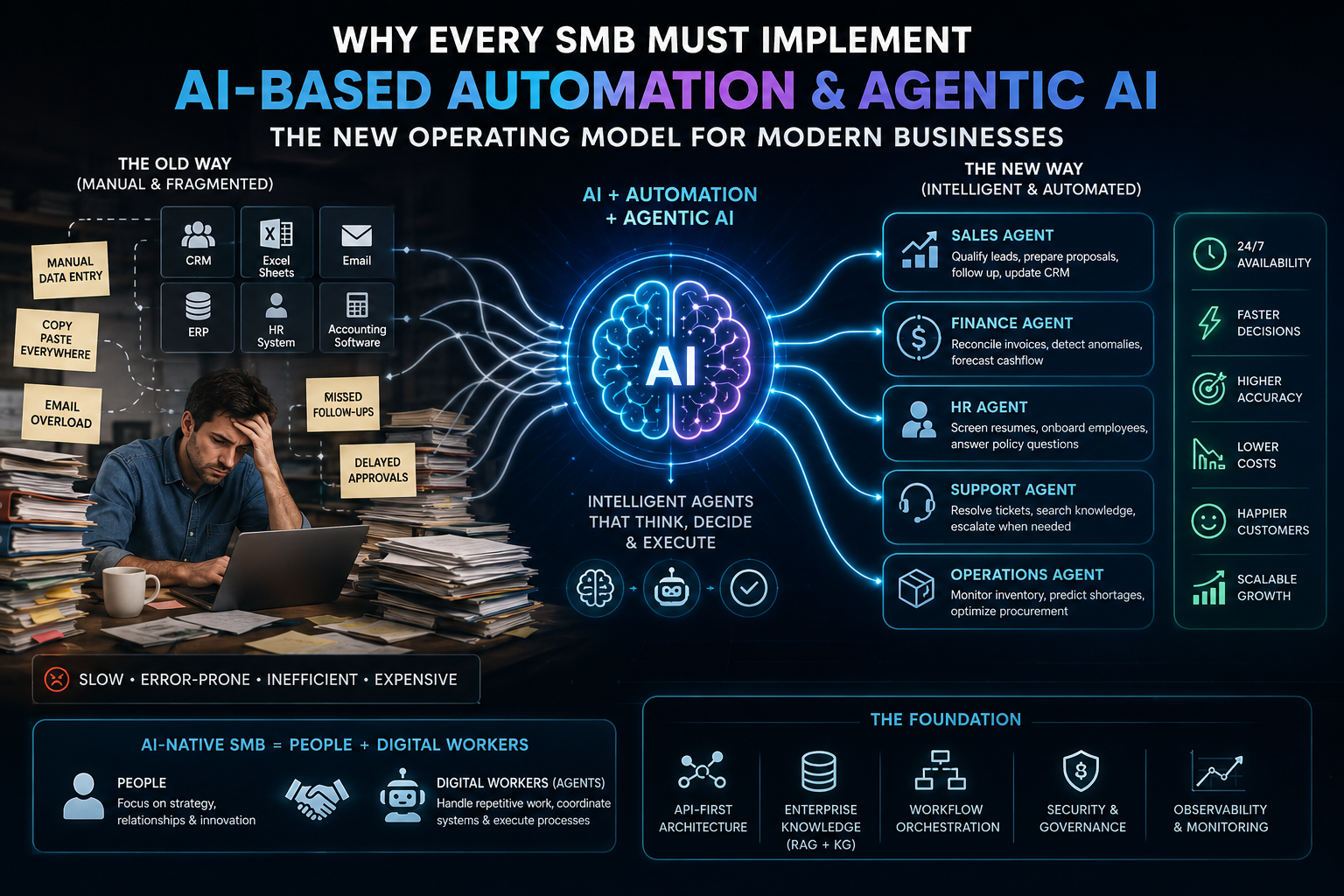
Why Every SMB Must Rethink Business Software: AI, Automation, and Agentic AI Are Becoming the New Operating Model
If you’ve been in the software industry long enough, you’ve probably noticed something interesting. Enterprise software has evolved dramatically over the last thirty years, yet the way businesses operate hasn’t changed nearly as much. We replaced paper forms with ERP systems, spreadsheets with cloud applications, filing cabinets with document management systems, and phone calls with collaboration platforms. On the surface, everything became digital. Underneath, however, the business process remained almost identical. Humans still move information from one system to another, verify data, chase approvals, answer repetitive emails, generate reports, and coordinate work across departments. In many organizations, employees have quietly become the middleware connecting applications that were never designed to work intelligently together.
This is exactly why AI for SMBs has become one of the most discussed topics in enterprise technology. The conversation is often reduced to chatbots and content generation, but that’s missing the bigger picture. AI is not replacing business software. It is changing the role of business software itself. Instead of applications acting as passive systems that store information, they are beginning to reason over information, automate decisions, coordinate workflows, and execute tasks. That architectural shift is far more significant than another productivity tool or another SaaS platform.
The timing couldn’t be better for small and medium-sized businesses. Unlike large enterprises burdened with decades of legacy systems, SMBs have the flexibility to redesign their technology stack around modern software principles. They don’t have to protect twenty-year-old architectures or maintain thousands of custom integrations built over decades. They can adopt cloud-native applications, expose APIs, integrate automation platforms, and introduce AI into business processes without carrying the technical debt that slows larger organizations. Ironically, being smaller has become an advantage because modernization is easier when the architecture is simpler.
Traditional Business Software Has Reached Its Natural Limit
Take a look at almost any SMB and you’ll find the same collection of applications. There is a CRM to manage customers, an ERP to handle operations, accounting software for finance, HR software for employees, a ticketing platform for customer support, email for communication, spreadsheets for everything that doesn’t fit elsewhere, and shared folders filled with documents. Every application performs its assigned responsibility reasonably well, yet none of them truly understands what the business is trying to accomplish.
A CRM knows that a customer exists but doesn’t know how to prepare the best proposal. The accounting system records invoices but doesn’t understand payment risks. HR software stores employee records but cannot mentor new hires. Your document repository contains thousands of valuable documents but has no understanding of the knowledge hidden inside them. Each system behaves like an isolated database optimized for storage rather than execution.
Software engineers often refer to CRUD applications—Create, Read, Update, Delete—as the foundation of enterprise systems. Most business applications still fit that model. They capture data, retrieve it when requested, modify it when necessary, and delete it when it becomes obsolete. That architecture worked extremely well for decades because computers were good at storing structured information. What they couldn’t do was interpret context. Every meaningful business decision required a human being to examine the data, understand the situation, and decide what should happen next.
Large Language Models introduce something enterprise software has historically lacked—a reasoning layer. Instead of merely storing information, software can now interpret documents, understand customer intent, summarize conversations, classify requests, detect anomalies, extract business knowledge, and recommend actions. That single capability fundamentally changes how enterprise applications are designed.
Automation Is No Longer About Saving Clicks
Automation has existed for years, but much of it was little more than digital assembly-line work. Workflow engines executed predefined steps, Robotic Process Automation mimicked mouse clicks, and scripts handled repetitive tasks. These solutions were useful, but they were fragile because they depended on rigid business rules. The moment a process changed, the automation failed. Every exception required additional programming, making automation expensive to maintain.
Modern AI automation behaves differently because it understands context before executing actions. Instead of following a fixed workflow, it evaluates the current situation and determines the most appropriate path. If a customer email contains a pricing question, the system identifies the intent, retrieves relevant product information, generates a response, updates the CRM, creates a follow-up task, and escalates only when confidence falls below predefined thresholds. The workflow adapts instead of breaking.
From a software architecture perspective, this is the difference between procedural execution and goal-oriented execution. Traditional automation asks, “What are the next five steps?” Intelligent automation asks, “What outcome is the business trying to achieve?” Once software begins optimizing for objectives instead of instructions, automation becomes significantly more resilient.
Agentic AI Is Changing Enterprise Architecture
The next phase is Agentic AI, and despite the hype surrounding the term, the underlying concept is surprisingly straightforward. Think about the difference between a function call and a long-running process. A function receives an input, performs work, returns a result, and exits. A long-running process maintains state, reacts to events, retries failed operations, collaborates with other processes, and continues executing until its objective is complete.
An AI assistant behaves much like a function call. You ask a question, receive an answer, and the interaction ends. An AI agent behaves like a long-running service. It receives an objective, decomposes it into tasks, invokes APIs, queries enterprise systems, retrieves knowledge through RAG, validates intermediate results, collaborates with specialized agents, and continues working until the business objective reaches a successful state.
This distinction may sound subtle, but it changes the architecture of enterprise software. Applications stop being independent tools waiting for users to click buttons. Instead, they become services participating in a coordinated execution pipeline driven by intelligent agents.
Every Department Can Have Digital Workers
Consider how a sales opportunity flows through a typical SMB. A lead arrives from the website. Someone enters it into the CRM. Another employee researches the customer. A proposal is prepared using an older document as a template. Pricing is requested from finance. Engineers estimate effort. Meetings are scheduled manually. Follow-up emails depend on individual discipline. Status updates are collected through meetings. None of these activities are particularly difficult, yet they consume a surprising amount of time.
Now replace that operational workflow with a collection of specialized agents. A Sales Agent qualifies the lead, enriches customer information, retrieves similar projects from the knowledge base, collaborates with a Pricing Agent to estimate commercial value, asks an Engineering Agent for technical estimates, generates a proposal, schedules meetings through calendar APIs, updates the CRM automatically, and informs the salesperson only when strategic decisions or negotiations require human expertise. The software performs operational execution while people focus on relationships and business strategy.
The same architectural pattern applies across the organization. Finance Agents reconcile invoices, monitor cash flow, detect unusual transactions, and generate executive summaries. HR Agents screen resumes, coordinate onboarding, answer policy questions, and prepare performance reports. Customer Support Agents classify incidents, search enterprise documentation using semantic search, draft accurate responses, and escalate only complex cases. Procurement Agents monitor inventory, compare supplier performance, predict stock shortages, and initiate purchase workflows automatically. Instead of isolated applications, the business operates as a coordinated ecosystem of intelligent digital workers.
APIs Are Becoming the Nervous System of the Modern Enterprise
None of this works without APIs. In fact, APIs are becoming far more important than user interfaces. Humans need screens because they consume information visually. AI agents need APIs because software communicates through structured interfaces. Every application that exposes clean APIs becomes immediately more valuable because intelligent agents can interact with it directly without relying on manual intervention.
This is one reason API-first architecture has gained so much momentum. A CRM that exposes customer information through secure APIs is significantly easier to integrate into an AI-driven workflow than one requiring manual exports or screen scraping. The same applies to ERP systems, HR platforms, accounting software, document repositories, and communication tools. Businesses preparing for AI adoption should spend as much time evaluating API capabilities as they spend evaluating product features.
Standards like the Model Context Protocol (MCP) are pushing the ecosystem even further by defining consistent ways for AI systems to access enterprise resources. Rather than building custom integrations for every application, organizations can expose standardized interfaces for documents, databases, developer tools, business systems, and internal services. As these standards mature, AI agents will communicate with enterprise software as naturally as web browsers communicate with websites today.
Knowledge Is Finally Becoming Searchable
One of the most underestimated assets inside any SMB is institutional knowledge. Every proposal, design document, contract, meeting transcript, support ticket, project plan, standard operating procedure, email thread, and technical manual contains valuable information. Unfortunately, most organizations have no practical way of retrieving that knowledge when it is needed.
Retrieval-Augmented Generation (RAG), vector databases, semantic search, and enterprise knowledge graphs solve this problem in a surprisingly elegant way. Instead of searching filenames or keywords, employees and AI agents search concepts. A support engineer can ask how a similar customer issue was resolved six months ago. A sales executive can retrieve proposals created for companies in the same industry. A developer can locate architectural decisions made years earlier. Knowledge becomes part of the execution pipeline rather than remaining trapped inside disconnected repositories.
AI Will Not Replace Good Employees
There is a recurring fear that AI will replace knowledge workers. That prediction oversimplifies how businesses actually operate. Organizations don’t create value because employees type quickly or copy data efficiently. They create value because people negotiate, innovate, mentor teams, build customer relationships, solve ambiguous problems, and make strategic decisions.
AI is exceptionally good at repetitive cognitive work. Humans remain exceptionally good at reasoning under uncertainty, understanding business context, exercising judgment, and building trust. The organizations that succeed will not replace employees with AI. They will eliminate repetitive operational friction so employees spend more time on work that genuinely requires human expertise.
Building an AI-Native SMB
The biggest mistake an SMB can make is assuming AI adoption begins by choosing a language model. Whether you deploy GPT, Qwen, Llama, Gemma, or Mistral is often one of the least important architectural decisions. Successful AI implementation begins with understanding business processes, documenting workflows, exposing APIs, organizing enterprise knowledge, establishing governance, and identifying repetitive activities that generate little business value.
The implementation strategy should be evolutionary rather than revolutionary. Start with one business process. Automate proposal generation. Introduce semantic enterprise search. Deploy an AI support assistant. Build an invoice processing workflow. Add specialized agents gradually. Measure improvements in response time, operational cost, accuracy, and employee productivity. Once the architecture proves reliable, expand the ecosystem instead of rebuilding it.
The Next Five Years Will Look Very Different
I don’t think every company needs dozens of AI agents or a room full of GPUs. I also don’t believe chatbots alone will transform businesses. What I do believe is that enterprise software is quietly evolving from systems of record into systems of execution. Software is beginning to understand intent, coordinate workflows, retrieve organizational knowledge, communicate through APIs, orchestrate automation, and execute business processes with minimal supervision.
If that prediction proves correct—and the current pace of innovation suggests it will—the competitive advantage for SMBs will no longer come solely from hiring more people or purchasing more software. It will come from building an operating model where AI, automation, APIs, enterprise knowledge, and Agentic AI work together as a coordinated digital workforce. Companies that begin building that foundation today will spend the next few years refining it. Companies that wait may eventually discover that the difficult part was never buying AI software. The difficult part was redesigning the business to take advantage of it.
 English